-
> Engineering and Consultancy
Through its Engineering & Consultancy structure, with the most up-to-date predictive and preventive techniques, Hilub offers another critical type of support to its clients, ensuring more equipment reliability, with an increased lifespan and expressive reduction in maintenance operational costs.
Among the offered services, we highlight:
Oil analysis and equipment diagnostics
-
Hilub offers its clients many diagnostic and equipment control tools, with detailed oil analysis and its invaluable information about condition of the equipment. This service has proven to be particularly efficient, either because it reduces maintenance costs or because it gains operational efficiency for the equipment.
Among the analysis, we have particle contamination control, ferrography, spectrometry, chromatography, besides physical-chemical analysis such as viscosity, TAN, TBN, flashpoint, water content, dilution, soot, non-solubles, saponification, worked penetration and others.
This monitoring generates an incredibly rich database that is used as a predictive diagnostic tool against failures, improving and optimizing the management system and the maintenance planning.
Among some of the chief benefits of this solution we emphasize:
- Among some of the chief benefits of this solution we emphasize:
- Detailed knowledge of profile and behavior of wear in the equipment's lubricated components;
- Assessment of lubricant conditions and extension of their lifespan, reducing direct costs;
- Prevention of failures and non-scheduled stops of machines, increasing their productivity;
- Possibility of data-crossing and information complementation using other techniques such as Vibration Analysis and Thermography;
- Available history and effective record of components' condition;
- Rationalization of lubricant consumption and workforce use, ensuring more economy;
- Higher reliability and operational availability of equipment;
- Compliance to norms ISO 9000, QS 14.000, OHSAS 18000.
-
-
Predictive Analyses
-
Aiming at aggregating more value to your services and systematic improvements to maintenance rates and operational availability of equipment of is clients, Hilub offers engineering solutions and equipment diagnostics correlating metallographic and vibration analyses, thermography and alignment, which ensure comprehensive knowledge to act on equipment.
With highly experienced engineers and technicians in lubrication, maintenance and process management, together with its 15-year experience in servicing a number of industrial segments in the country, Hilub holds an advanced benchmark with performance indicators, deep knowledge and technical safety. All this together with constant updates and access to international references ensure higher standards of service and solutions that align cutting-edge tendencies in maintenance with its clients’ needs.
Main solutions accessible at Hilub in partnership with high-tech businesses comprise:
-
-
Equipment monitoring by Systematic Analysis of Lubricating Oils
-
Using the lubricant as an isolated medium to identify operational behavior and malfunction in the equipment or together with other methodologies like Vibrational Analysis and Thermography, is undoubtedly a powerful maintenance tool for diagnostics and planning
-
-
Tool applicability and benefits
-
Equipment and its operating components constantly suffer contamination, either from external sources or from its own operation. At the same time, the normal wear of components in use may change due to contamination itself and the applied load.
Therefore, the lubricant degrades and suffers some alterations in its properties that when detected throughout their use may generate critical information to prevent failure and loss of operational efficiency.
For proper categorization of services, it is essential to have the conceptual definition of expectation levels on maintenance and its relation with the kind of analyses to perform on the lubricant.
Hence, the first level is related to the importance of monitoring the lubricant’s adequate physical-chemical properties during operation periods. This ensures the proper conditions of operation, lubrication and energy conservation. In this case, characteristics like viscosity, water contamination and acidity are essential tests to monitor the ideal conditions of operation.
A third level could be defined using qualitative ferrography and metallographic analysis for cases where the failure actually occurred, allowing for an exact, root-cause diagnostic and the identification of corrective actions to prevent the failure from recurring.
-
-
Tests performed
-
To obtain information relative to component operation and conditions of lubricating oils, it is usual to submit different samples to specific lab tests by type of equipment and lubricant line, whose sequence will depend on the way maintenance is done and on the general management policy that is being applied.
Hilub makes all these lab tests available for used lubricants such as:
- KF = Water content by Karl Fischer’s method (ASTM D 1744):
- TAN = Total acidity number (ASTM D 664);
- TBN = Total acidity number (ASTM D 664);
- VISC = Kinematic viscosity at 40 ºC (ASTM D 445);
- OX = Oxidação Oxidation by infrared emission;
- FUL = Soot by infrared emission;
- SP = Roto-rooter spectometry by atomic emission;
- CP = Particles count – Grade NAS 1638/ISO 4406
- DR = Quantitative ferrography;
- AN= Analytical ferrography;
- MV= Failure analysis by microscopic scanning;
-
-
Program setup and Diagnostics
-
The program is set to perform periodic collection, by service time or pre-set mileage for each type of installation and equipment manufacturer.
In general, the first oil collection is done when the factory-recommended period for change is reached. When there is interest in extending the lubricant use, further collections are performed in timeframes corresponding to half of the time of the first collection until the product is considered unfit.
All these criteria may be discussed and adapted for each specific case and according to the needs of each equipment /installation.
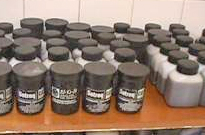
Samples are collected and organized with proper identification.
Spare samples follow retention standards and remain available until the lab reports return.
Also, when needed, morphological studies of solid particles and waste are carried out through stereoscopic and microscopic exams of the oil slide, and in some cases microphotos of such particles will be attached to the report to better illustrate the analysis commentaries.
Grease-lubricated Systems
For the sake of wear control and predictive maintenance of grease-lubricated systems a trial test is performed with the morphological studies of Solid Particles of Wear and Atomic Absorption Spectrometry.
-
-
Diagnostics and Results
-
The more representative the point sample is the more reliable and precise the results will be. Sampling frequency must be established according to the objectives and level of desired service. Frequency may be set as weekly, fortnightly, monthly, every 2, 3 or 6 months, or annually. The interval will depend on the rigor of the application, type of oil, how critical the operation is or any other parameter considered relevant to the process.
-
Vibration Analysis
Process through which failures in mobile components of equipment are discovered by the variation rate of the generated dynamic forces. Such forces affect the level of vibration, which can be evaluated in accessible points in the machines, without having to halt their operation;
-
Thermography
Mechanical inspections utilizing infrared Thermography apply to all equipment and installations in which temperatures is a measurable variable in a failure analysis process. Examples are bearings, shafts, pulleys, transporters, pumps, fans etc.
-
-
-
Lubricant Leakage Control
-
Hilub’s teams monitor oil and grease leaks at lubrication points through consumption controls by point and by type of lubricant, acting on repairs to gaskets, sealants and hoses, in partnership with the Company's Maintenance team.
-
-
Training
-
Through its CTH - Training Center Hilub offers a number of training and specialization modules in lubrication for a wide range of needs such as Practical and theoretical courses for oilers, supervisors, engineers, mechanics and operators; Lubrication TPM; Consultancy for ISO/QS9000 and ISO 14000 in lubrication and courses for tests and certification of special lubricants.
Our courses follow the PNQC (Program for National Qualification and Certification)) and the ABRAMAN’s CEQUAL, where we perform the Qualification for the Certification exam.
-
-
Consultancy
-
Through its engineering team, Hilub offers studies for the development of products with better cost-benefit, specific systems and projects, and reviewing and improving existent processes for each technical area, in synch with the company's needs.
All these services can be performed separately or included in the Integrated Lubrication Management contract, so as to ensure more efficiency and additional gains in all processes.
-